IBCC Equivalence for O Levels, A Levels and Foreign Qualifications: 2026 Fee, Online Steps and Timeline

Written by Muhammad Hammad, Founder & Lead Study Abroad Counsellor
Published · 8 min read
IBCC equivalence is the Inter Boards Coordination Commission's certificate that converts O Level, A Level or foreign school results into the Pakistani Matric or Intermediate standard. Pakistani students need the certificate for local admission, many scholarships and some visas. In 2026 the normal fee is Rs 4,000 to Rs 6,000 per qualification.
- Foreign qualification
- Rs 6,000
- Urgent (foreign)
- Rs 12,000
- Payment
- 1Bill · Easypaisa · JazzCash
What is an IBCC equivalence certificate?
An IBCC equivalence certificate is an official document from the Inter Boards Coordination Commission that states which Pakistani level, Matric or Intermediate, a student's O Level, A Level or foreign school qualification equals. The certificate also shows equivalent marks, which universities and scholarship bodies use to compare applicants.
Equivalence is different from attestation. Equivalence converts a foreign or Cambridge result, and attestation confirms that a Pakistani board certificate is genuine.
University degrees follow a separate route through HEC. The HEC degree attestation page covers Bachelor's and Master's documents.
Who needs IBCC equivalence for study abroad?
O Level and A Level students, students with American high school diplomas or IB results, and Pakistanis who finished school abroad usually need IBCC equivalence. Pakistani FSc and ICS students do not need equivalence, because their board certificates already follow the Pakistani system and only need attestation where asked.
- O Level students, for Matric equivalence.
- A Level students, for Intermediate equivalence.
- IB Diploma or American high school graduates.
- Students who completed school in the Gulf or another country.
- Applicants to HEC or Pakistani government scholarships.
Bachelor's applicants abroad check whether the university wants Cambridge results or IBCC marks. The Bachelors in UK for Pakistani students page covers how UK universities read A Levels and FSc.
How much does IBCC equivalence cost in 2026?
IBCC lists an equivalence fee of Rs 6,000 per foreign qualification and Rs 4,000 per local qualification on normal service, and Rs 12,000 for urgent foreign equivalence. Verification of existing documents costs Rs 600 per certificate plus Rs 300 courier charges. Students pay through 1Bill.
| Service | Fee | Note |
|---|---|---|
| Equivalence, foreign qualification | Rs 6,000 each | O Level, A Level, IB, foreign |
| Equivalence, local qualification | Rs 4,000 each | Normal service |
| Urgent equivalence, foreign | Rs 12,000 each | Faster processing |
| Manual verification | Rs 600 per certificate | Plus Rs 300 courier |
| QR-code verification | Free | Online on the IBCC site |
Fees are set by IBCC and change over time. Students confirm the amount on ibcc.edu.pk before paying, because older figures still circulate on social media.
How do you apply for IBCC equivalence online?
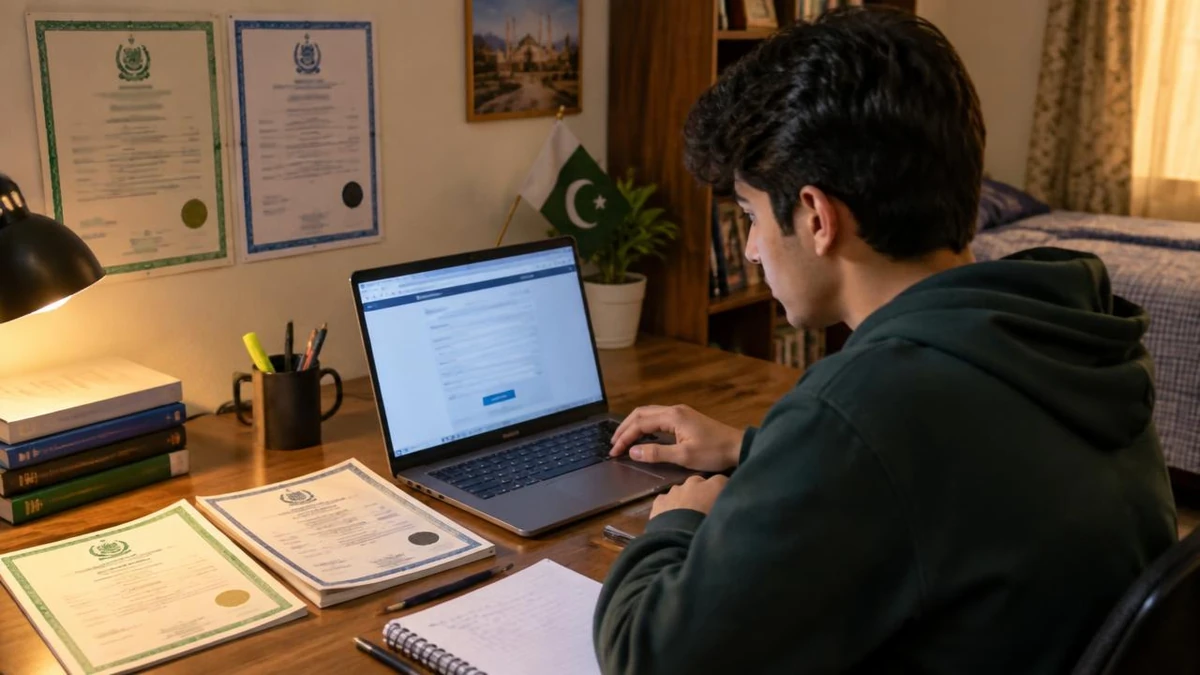
Students apply for IBCC equivalence by filling in the online form with personal details, uploading educational certificates and a CNIC copy, paying the fee through 1Bill with a mobile banking app, Easypaisa or JazzCash, then following the submission mode IBCC assigns until the certificate is issued.
- 1Open the IBCC portal. Create an account on the official ibcc.edu.pk equivalence system.
- 2Fill in the form. Add personal details exactly as on the passport and CNIC or B-Form.
- 3Upload documents. Add O Level or A Level statements of entry and certificates, plus a CNIC copy.
- 4Choose normal or urgent. Pick the service level that matches your deadline.
- 5Pay through 1Bill. Use a banking app, Easypaisa, JazzCash or a bank to pay the generated bill.
- 6Follow the submission mode. Submit originals by courier or in person if IBCC asks for them.
- 7Collect the certificate. Keep scans of the final certificate for every application.
Students who sit A Levels in May usually wait for August results before applying. Applying straight after results leaves time before Pakistani and foreign deadlines.
How long does IBCC equivalence take?
IBCC information points to roughly 15–20 working days on normal service, with a faster urgent option for an extra fee. Delays come from missing documents, unclear scans or courier time. Students should apply as soon as results arrive and at least six weeks before their first scholarship or admission deadline.
Scholarship deadlines often come first. The Türkiye Bursları scholarship page closes on 20 February, and the Stipendium Hungaricum scholarship page shows a mid-January round.
UCAS deadlines for UK Bachelor's applications fall in October and January. Students applying with A Level predictions usually send the equivalence later, once final grades are issued.
Do universities abroad accept IBCC equivalence?
Universities abroad usually read original Cambridge or IB results first and may ask for IBCC equivalence as supporting proof. Scholarship bodies such as HEC, Stipendium Hungaricum and Türkiye Bursları often compare Pakistani applicants by IBCC marks. Embassies sometimes check equivalence when the student lists a Pakistani school record.
Medicine applicants face an extra check. The MBBS in Turkey for Pakistani students page explains how PMDC reads FSc or equivalent marks before study abroad.
Turkish universities often ask for YÖS or SAT as well. The YÖS exam page explains when the test replaces school marks.
Which documents need IBCC and which need HEC?
IBCC handles school-level documents: equivalence for O Levels, A Levels and foreign school results, and attestation of Pakistani Matric and FSc certificates. HEC handles university documents: attestation of degrees, transcripts and provisional certificates, plus equivalence letters for foreign degrees. Most students going abroad need both bodies.
| Document | Body | Service |
|---|---|---|
| O Level results | IBCC | Matric equivalence |
| A Level results | IBCC | Intermediate equivalence |
| Matric / FSc certificate | IBCC | Attestation |
| Bachelor's or Master's degree | HEC | Degree attestation |
| University transcript | HEC | Transcript attestation |
| Foreign university degree | HEC | Equivalence letter |
Doing both steps in the same month keeps the file complete. Many embassies and universities ask for the school and university record together.
The order of steps also matters. Students with O and A Levels finish IBCC equivalence first, because HEC and some universities ask for the equivalence certificate when checking the degree file. Pakistani board students skip equivalence and go straight to IBCC attestation.
Keep both original sets and colour scans in one folder. Embassies, universities and scholarship portals often ask for the same attested pages, and a clean folder saves repeat visits to Islamabad or regional IBCC offices.
Students with a degree can follow the step-by-step HEC attestation process once IBCC work is done. Applicants to Turkey can check the study in Turkey from Pakistan page for the document list there.
Which IBCC equivalence mistakes delay Pakistani students?
The mistakes that most often delay IBCC equivalence are applying weeks after results, uploading unclear scans, typing names differently from the passport, paying the wrong service fee, waiting for a scholarship deadline before starting, and mixing up equivalence with attestation for FSc certificates.
- Applying only when a scholarship deadline is days away.
- Uploading blurred phone photos of certificates.
- Spelling the name differently from the passport.
- Choosing normal service when the deadline needs urgent.
- Requesting equivalence for an FSc that only needs attestation.
A free document check with Hammad Study Abroad confirms which IBCC and HEC steps your target universities need. Students comparing options can read the scholarships for Pakistani students page.
IBCC equivalence, frequently asked questions
What is the IBCC equivalence fee in 2026?
The IBCC equivalence FAQ lists Rs 6,000 per foreign qualification and Rs 4,000 per local qualification on normal service, with an urgent fee of Rs 12,000 for foreign qualifications. Students pay through 1Bill using a mobile banking app, Easypaisa or JazzCash.
Is IBCC equivalence the same as IBCC attestation?
No. IBCC equivalence converts O Level, A Level or foreign school results into the Pakistani Matric or Intermediate standard. IBCC attestation confirms that a Pakistani Matric or FSc certificate is genuine. Many students abroad need attestation, while O and A Level students need equivalence first.
How long does IBCC equivalence take?
IBCC information indicates roughly 15–20 working days on normal service, and the urgent option is faster for an extra fee. Students should apply as soon as final results arrive, because universities and scholarships abroad often ask for the equivalence certificate with the application.
Do I need IBCC equivalence to study abroad?
Often, yes. O and A Level students usually need IBCC equivalence for Pakistani university admission and for many scholarship or embassy checks. Universities abroad may accept original Cambridge results, so the requirement depends on the university, the scholarship and the visa.
Can I apply for IBCC equivalence online?
Yes. IBCC runs an online equivalence form. Students fill in personal details, upload educational certificates and a CNIC copy, pay the fee through 1Bill and then follow the submission mode IBCC selects for the case. Keep scans of every uploaded document for later applications.
How do I verify an IBCC document?
IBCC documents carrying a QR code can be verified online free of charge on the IBCC verification page. Manual verification costs Rs 600 per certificate plus Rs 300 for courier charges, according to the IBCC verification rules. Universities abroad can use the same online check.