Masters in UK for Pakistani Students: 2027 Requirements, Costs and Courses
Masters in UK for Pakistani students means earning an MSc, MA or MBA in just 12 months. Most universities ask for a 16-year degree, a CGPA of about 2.5 to 3.0 and IELTS 6.5. Tuition runs £11,000 to £25,000, and intakes open in September and January each year.
- Duration
- 12 months (taught)
- Entry
- 16-yr degree · CGPA 2.5+ · IELTS 6.5
- Tuition
- £11,000 – £25,000
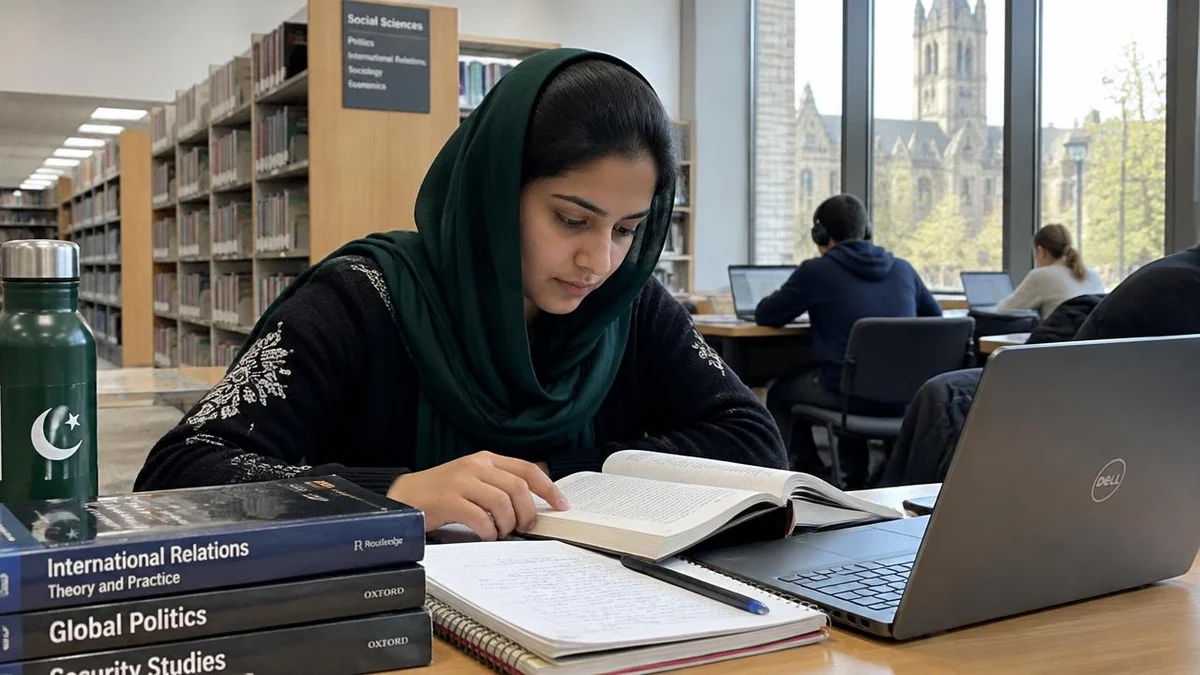
What types of Master's degrees can Pakistani students study in the UK?
Pakistani students can choose taught Master's degrees such as the MSc, MA, MBA and LLM, research degrees such as the MRes and MPhil, or a Master's with a placement year. Taught courses last 12 months and are the most popular, while research degrees suit students planning a PhD or an academic career.
| Degree | Length | Best for |
|---|---|---|
| MSc / MA (taught) | 12 months | Modules plus a summer dissertation; the most common choice |
| MBA | 12 months | Business leadership; usually needs 2–3 years of work experience |
| MRes (research) | 12 months | Mostly research project; a route towards a PhD |
| MPhil (research) | ≈ 2 years | Full research degree; allows dependants on the visa |
| Master's with placement | ≈ 2 years | Taught year plus one year in industry |
| LLM | 12 months | Postgraduate law for LLB holders |
The MPhil and other research Master's matter for married students. Dependants are allowed on the Student visa only for postgraduate research courses, so a taught MSc does not allow a spouse to join.
Master's students make up the largest share of Pakistani applicants to Britain. The wider reasons Pakistani students pick Britain over other countries are covered in the guide on why Pakistani students choose UK universities.
Which Pakistani degrees are accepted for a UK Master's?
UK universities accept a 16-year Pakistani Bachelor's, or a 14-year degree followed by a two-year MA or MSc, for most Master's courses. A 14-year BA or BSc alone is accepted only by some universities. Most taught programmes ask for a CGPA of roughly 2.5 to 3.0 out of 4.0.
| Your qualification | UK acceptance | Typical condition |
|---|---|---|
| 16-year Bachelor's (BS 4-year) | Accepted by almost all UK universities | Minimum CGPA ≈ 2.5–3.0 / 4.0 |
| 14-year BA / BSc + 2-year MA / MSc | Accepted as 16 years of education | Final Master's grade counts most |
| 14-year BA / BSc only | Rarely accepted on its own | Usually needs a pre-Master's course |
| Engineering degree (BE / BSc Eng) | Accepted widely | PEC-accredited degrees are preferred |
| MBBS / BDS | Accepted for health Master's | Clinical experience strengthens the profile |
Each university publishes a Pakistan country page with its exact grade rules. Most universities read CGPA 2.5 or about 55% as a UK 2:2, the usual minimum. Russell Group universities often set the bar near 3.0 to 3.3. The difference between Russell Group and modern options is explained in the types of UK universities page.
Applicants with a low CGPA can still strengthen a profile with two or more years of relevant work experience. A pre-Master's course of one or two terms is another route for 14-year graduates.
Several UK universities paused or limited Pakistan recruitment in 2026 under stricter Home Office compliance rules. Students should confirm that a university is accepting Pakistani applicants for the chosen course before paying any application fee.
What IELTS score is needed for a Master's in the UK?
Most UK Master's courses ask Pakistani applicants for IELTS 6.5 overall with no band below 6.0. Business, law and health courses may ask for 7.0. Many universities also accept PTE Academic, an in-house English test, or a waiver for graduates whose Pakistani degree was taught in English.
- IELTS Academic UKVI: 6.5 overall, 6.0 in each band for most courses.
- PTE Academic: around 58–64 overall at most universities.
- English-medium degree waiver: offered by some universities with a university letter.
- University online test: used by several universities for Pakistani applicants.
- Pre-sessional English: a 6–12 week course for students slightly below the score.
Universities state the exact score on the offer letter, and the CAS repeats it. The full list of accepted tests and waiver rules is compared in the section on IELTS requirements for UK universities.
Which Master's subjects are most popular with Pakistani students?
Data science, computer science, MBA, engineering, public health, finance and project management are the most popular UK Master's subjects among Pakistani students. These fields offer strong job demand on the Graduate visa and in Pakistan. Tuition for these courses usually ranges from about £14,000 to £30,000 per year.
| Subject | Tuition per course | Note |
|---|---|---|
| Data Science / AI | £17,000 – £30,000 | Strong demand; needs maths or programming background |
| Computer Science | £17,000 – £29,000 | Conversion courses accept non-IT graduates |
| MBA | £18,000 – £45,000 | Work experience required; London top schools cost most |
| Engineering | £18,000 – £30,000 | Mechanical, civil and electrical are popular |
| Public Health | £14,000 – £25,000 | Good fit for MBBS and pharmacy graduates |
| Finance / Accounting | £16,000 – £32,000 | ACCA holders gain exemptions on some courses |
| Project Management | £14,000 – £22,000 | Popular with engineers and IT professionals |
Conversion Master's programmes let graduates switch fields, such as a commerce graduate moving into computer science. Universities still expect a clear reason for the switch in the personal statement.
How much does a one-year UK Master's cost in Pakistani rupees?
A one-year UK Master's costs Pakistani students roughly PKR 85 lakh to 1.4 crore in total. Tuition takes the largest share at £11,000 to £25,000. Visa rules also require living-cost evidence of £10,539 outside London or £13,761 in London for nine months, plus the health surcharge and visa fee.
| Cost item | Amount (GBP) | Approx. PKR (£1 ≈ PKR 367) |
|---|---|---|
| Tuition (1-year taught Master's) | £11,000 – £25,000 | PKR 40 – 92 lakh |
| Living costs outside London (9 months, visa rule) | £10,539 | PKR 39 lakh |
| Living costs in London (9 months, visa rule) | £13,761 | PKR 51 lakh |
| Immigration Health Surcharge (≈ 1.25 years) | ≈ £970 | PKR 3.6 lakh |
| Student visa application fee | £558 | PKR 2 lakh |
The living-cost figures above follow UKVI rules in force until 29 November 2026. Monthly amounts rise to £1,570 in London and £1,203 elsewhere from 30 November 2026.
Bachelor's, accommodation and city-by-city costs appear in the full UK study cost breakdown in rupees. Funding options such as Chevening and GREAT awards are compared in the guide to fully funded Master's scholarships in Britain.
Which month should you apply for a September or January Master's?
UK Master's courses start mainly in September, with a smaller January intake and a few May starts. Pakistani students should apply between October and March for September entry. Popular courses at top universities can close early, and visa funds must be held for 28 days before applying.
- September intake: widest course choice; apply October to March.
- January intake: fewer courses; apply by September or October.
- May intake: limited options at some modern universities.
- Rolling admissions: many universities review applications as they arrive.
- CAS timing: usually issued 2–3 months before the course starts.
Applying early also leaves time to hold visa funds for 28 days. A month-by-month plan for a September start is set out in the UK intakes calendar for Pakistani students.
What does a UK Master's application involve, from shortlist to CAS?
Applying for a UK Master's from Pakistan takes eight steps: check degree equivalence, shortlist courses, take IELTS or PTE, write a personal statement, gather two references, apply on university portals, accept an offer and pay the deposit, then pass the pre-CAS interview to receive your CAS.
- 1Check your degree equivalence. Confirm whether each university accepts a 14-year or needs a 16-year degree.
- 2Shortlist 5–6 courses. Compare modules, ranking, city and tuition, not just university names.
- 3Take IELTS or PTE. Aim for 6.5 overall with no band below 6.0 for most courses.
- 4Write your personal statement. Link your Bachelor's, work experience and career plan to the course.
- 5Collect two references. Ask a teacher and, if employed, a line manager.
- 6Apply through university portals. Master's applications go directly to universities, not through UCAS.
- 7Accept an offer and pay the deposit. Deposits usually range from £2,000 to £5,000.
- 8Complete the pre-CAS interview and get your CAS. Then apply for the Student visa.
The pre-CAS interview checks why you chose the course and how you will fund it. Sample answers are in the guide to UK credibility interview questions.
After the CAS, the visa stage needs bank evidence, TB test and biometrics. Every document is listed in the UK student visa checklist for Pakistan.
Can Pakistani students work in the UK after a Master's?
Yes. Pakistani students who finish a UK Master's can apply for the Graduate visa, which allows work without a sponsor. Graduates who apply by 31 December 2026 get two years, and applications from 1 January 2027 get 18 months. Graduates can then switch to a Skilled Worker visa with a job offer.
Students may work up to 20 hours a week during term time on a Master's. Full-time work is allowed during official university vacations and after the course ends.
Pakistani employers value a British Master's, especially in finance, IT and the public sector. Graduates returning home should complete HEC degree attestation for government jobs or a local PhD.
Which low-CGPA and course-choice errors stop Master's applications?
Common mistakes include picking a course unrelated to your degree, assuming every university accepts a 14-year degree, applying too late, budgeting only for tuition, trusting an agent's commission-driven choice and writing a generic personal statement. Each mistake can lead to a rejected application, a refused CAS or an unaffordable final budget.
- Applying to a course unrelated to your Bachelor's degree or work history.
- Assuming every university accepts a 14-year degree.
- Applying in summer for a September course after popular programmes have filled.
- Budgeting for tuition only and forgetting living-cost evidence.
- Choosing a university only because an agent gets a commission there.
- Writing a generic personal statement copied from the internet.
An honest profile check before applying avoids most of these problems. Hammad Study Abroad offers a free UK Master's profile check with our international education consultants with a shortlist based on your degree, CGPA and budget.
Masters in UK, frequently asked questions
Can I do a UK Master's after a 14-year BA or BSc?
A Pakistani 14-year BA or BSc is rarely enough on its own for a UK Master's, because most universities expect 16 years of education. The usual routes are a two-year MA or MSc after the BA, or a pre-Master's course in the UK. A few universities assess strong 14-year profiles with long work experience case by case.
What CGPA do I need for a UK Master's?
Most UK universities ask Pakistani applicants for a CGPA of about 2.5 to 3.0 out of 4.0 for a taught Master's. Higher-ranked universities such as Russell Group members often expect 3.0 to 3.3. Universities may treat grades from HEC-ranked institutions differently, so results vary by where you studied.
Is a one-year UK Master's recognised by HEC Pakistan?
HEC Pakistan generally recognises one-year UK Master's degrees from recognised British universities as equivalent to an MS or MPhil, subject to its degree attestation and equivalence process. Pakistani graduates who plan a government job or a PhD in Pakistan should confirm the latest HEC equivalence criteria before enrolling.
Can I get a UK Master's without IELTS?
Several UK universities accept Pakistani applicants without IELTS for a Master's, using PTE Academic, the university's own English test, or a waiver for English-medium degrees. The waiver depends on the university and course. A visa interview still checks spoken English, so a waiver does not remove the need for good English.
Is a UK Master's with placement worth it?
A UK Master's with a professional placement adds a paid or unpaid work year, making the course about two years long. Pakistani students gain British work experience and a stronger CV. The trade-off is an extra year of living costs and a higher total budget, so the option suits students with clear industry goals.
Which UK Master's subjects lead to the best jobs?
UK Master's subjects with strong job demand include data science, computer science, engineering, finance, nursing and public health. Pakistani graduates choosing these fields find more openings on the Graduate visa and in Pakistan's growing tech and finance sectors. Choose a subject that builds on your Bachelor's degree for a credible profile.
How long does a UK Master's take?
A taught UK Master's such as an MSc, MA or MBA usually takes 12 months full time, including a dissertation in the summer. A research MRes also takes about one year, while placement routes take up to two years. An MPhil by research normally runs two years in the UK.
Can I apply to a UK Master's with a study gap?
Pakistani graduates can apply to a UK Master's with a study gap of several years. Universities accept gaps that are filled with work experience, family duties or further courses. Keep experience letters and dates ready, because both the university and the visa interviewer will ask you to explain the gap.