Study in the Netherlands from Pakistan: 2026 Guide to Universities, Costs, the Study Permit and Orientation Year
Pakistani students can study in the Netherlands in English-taught degrees at research universities and universities of applied sciences, applying through Studielink. For 2026, the study permit needs proof of about €1,130.77 a month, roughly PKR 3.6 lakh, and the Dutch university applies to the IND for the student. Graduates can stay for an orientation year to find work.
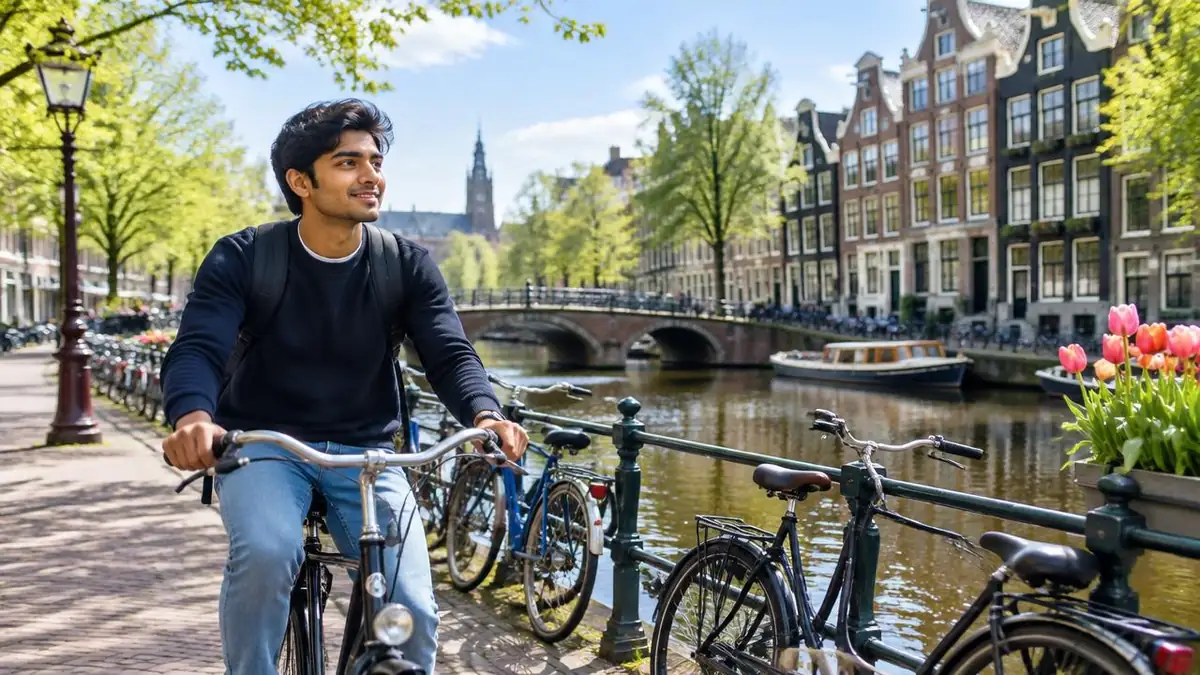
- Funds (2026)
- €1,130.77 / month
- Permit fee
- €254
- Work in term
- 16 hrs / week
Why do Pakistani students choose to study in the Netherlands?
Pakistani students choose to study in the Netherlands for English-taught degrees at both research universities and universities of applied sciences, English spoken widely in daily life, strong international employers and the orientation year, which lets graduates stay a full year to find work. Dutch teaching is also highly practical and project-based.
Popular universities include Delft, Eindhoven, Amsterdam, Leiden, Utrecht, Groningen and Erasmus Rotterdam. Engineering, data science, business and logistics attract most Pakistani applicants.
The Netherlands is costly, with a serious housing shortage. Families comparing budgets should also read the tuition-free route to Germany from Pakistan and the full Europe country comparison.
How much does it cost to study in the Netherlands from Pakistan?
Studying in the Netherlands from Pakistan costs about PKR 70 lakh to 1.2 crore for the first year, including tuition of €9,000–25,000 and living costs. For 2026, university and HBO students show about €1,130.77 a month, roughly €13,569 or PKR 43 lakh for twelve months, and the study permit costs €254.
| Item | Amount (EUR) | Approx. in PKR |
|---|---|---|
| Tuition, research university (per year) | €12,000 – 25,000 | ≈ PKR 38 – 80 lakh |
| Tuition, HBO (per year) | €9,000 – 15,000 | ≈ PKR 29 – 48 lakh |
| Funds to show (2026) | €1,130.77 / month | ≈ PKR 3.6 lakh / month |
| Funds for 12 months | ≈ €13,569 | ≈ PKR 43 lakh |
| Study permit fee | €254 | ≈ PKR 81,000 |
| Rent (student room) | €500 – 1,000 / month | ≈ PKR 1.6 – 3.2 lakh / month |
| Flight Pakistan to the Netherlands | - | ≈ PKR 1.7 – 2.8 lakh |
PKR figures use €1 ≈ PKR 320 (3 Oct 2026). The funds figure is updated each January and July, so check the IND page before paying.
Most Dutch universities collect the twelve-month funds before applying to the IND. The money is then paid back to the student in monthly instalments after arrival.
What are the entry requirements for Pakistani students in the Netherlands?
Pakistani students need FSc or A-Levels for an HBO Bachelor's, usually A-Levels or a foundation year for a research-university Bachelor's, and a relevant 16-year degree for a Master's. Dutch institutions also ask for IELTS 6.0–6.5 or TOEFL, HEC-attested documents and a motivation letter for the specific programme.
- Master's: a relevant 16-year Bachelor's degree, assessed course by course by each university.
- Bachelor's at HBO: FSc, ICS or A-Levels with the subjects the programme needs.
- Bachelor's at a research university: usually A-Levels, a year of university or a foundation year.
- English: IELTS Academic 6.0–6.5 or TOEFL iBT 80–90.
- HEC-attested degree and transcripts, and IBCC-attested intermediate certificates.
- A motivation letter, CV and sometimes references or a portfolio.
Dutch universities assess each Pakistani degree course by course. Strong subject matches matter more than the university's name.
How do I apply to Dutch universities through Studielink?
Pakistani students register on Studielink, the Dutch enrolment system, then complete each university's own application with HEC-attested documents, IELTS and a motivation letter. After accepting an offer, they pay tuition and the twelve-month funds to the university, which applies to the IND for the MVV and residence permit.
- 1Shortlist programmes. Use Study in NL and university sites to compare research universities and HBO institutions.
- 2Register on Studielink. Create a Studielink account and request enrolment for up to the allowed programmes.
- 3Complete the university application. Upload HEC-attested documents, IELTS, CV and motivation letter in the university portal.
- 4Receive the admission decision. Accept the offer and confirm housing early.
- 5Pay tuition and funds. Transfer tuition and the twelve-month funds to the university, which acts as sponsor.
- 6University applies to the IND. The university files the MVV and residence permit application and pays or recharges the €254 fee.
- 7Collect the MVV in Islamabad. Give biometrics and collect the entry visa at the Embassy of the Netherlands.
- 8Collect the permit and register. Register with the municipality and collect the residence card after arrival.
The university is the official sponsor, so students cannot apply to the IND alone. Starting in October gives time for scholarships and housing.
Which scholarships can Pakistani students get in the Netherlands?
Pakistani students in the Netherlands can apply for the NL Scholarship, a one-off €5,000 award offered by many Dutch universities, plus university excellence scholarships that can cover tuition and living costs. Erasmus Mundus joint degrees with Dutch partners are another strong option. Most deadlines fall between December and February.
| Scholarship | What it covers | How to get it |
|---|---|---|
| NL Scholarship | €5,000 one-off, first year | Offered by many Dutch universities |
| Orange Tulip Scholarship (where offered) | Partial or full tuition | Country-specific; check current partner list |
| University excellence scholarships | Tuition waiver plus living costs at top levels | e.g. Holland, Amsterdam Merit, Leiden Excellence |
| Erasmus Mundus joint degrees | Tuition, travel, monthly allowance | Many include a Dutch university |
Dutch scholarship places are limited and usually need early admission. Joint Master's options are covered in the Erasmus Mundus scholarship page.
How do Pakistani students get a Netherlands study permit?
Pakistani students get a Netherlands study permit through their Dutch university, which applies to the IND for an MVV entry visa and residence permit together. The student provides the passport, documents and proof of €1,130.77 a month. After approval, the MVV is collected at the Embassy of the Netherlands in Islamabad.
The IND usually decides within a few weeks when the university files a complete application. Students then register with the Dutch municipality and collect the residence card.
The university must report to the IND if study progress is insufficient. Passing enough credits each year protects the permit.
When are the Netherlands university intakes and deadlines?
The Netherlands' main intake starts in September, and applications open on Studielink in October. Non-EU deadlines usually fall between 1 February and 1 May, while scholarship deadlines come earlier, from December to February. Pakistani students then transfer funds and the university applies to the IND between May and July.
| Stage | Typical timing | Note |
|---|---|---|
| Studielink and applications open | October | For September start |
| Scholarship deadlines | December – February | Earlier than admission deadlines |
| Non-EU admission deadlines | 1 February – 1 May | Varies by university |
| Funds transfer and IND application | May – July | University files the MVV |
| February intake | Applications by October | Limited programmes |
IELTS and HEC attestation should be finished by October. Housing searches should begin as soon as the offer arrives.
Can Pakistani students work and stay in the Netherlands after study?
Yes. Non-EU students may work up to 16 hours a week during the year, or full-time in June, July and August, with an employer work permit. After graduating, students can apply to the IND for the orientation year, a one-year permit to look for work or start a business without work restrictions.
A job found during the orientation year can lead to a highly skilled migrant permit at a lower salary threshold for recent graduates. Permanent residence usually comes after five years of legal residence.
Details are on the IND orientation year page.
Which mistakes delay Pakistani students applying to the Netherlands?
The mistakes that most often delay Pakistani students applying to the Netherlands are treating FSc as enough for a research university, missing early scholarship deadlines, late funds transfers, arriving without housing, working without an employer work permit and falling behind on credits that the university reports to the IND.
- Treating FSc as enough for a research-university Bachelor's.
- Missing scholarship deadlines that fall months before admission deadlines.
- Transferring funds late, which delays the IND application.
- Arriving without confirmed housing in a city with a room shortage.
- Working without the employer's work permit.
- Falling behind on study progress, which the university must report to the IND.
A free Netherlands profile check with our education consultants in Pakistan reviews your degree, IELTS and funds before you apply.
Study in the Netherlands from Pakistan, frequently asked questions
How much bank balance is needed for a Netherlands student visa?
For 2026, university and HBO students must show about €1,130.77 a month, roughly €13,569 for twelve months or PKR 43 lakh, on top of tuition. The money is usually transferred to the Dutch university, which sends it back to the student monthly after arrival.
Is study in the Netherlands expensive for Pakistani students?
Yes, compared with Germany or Italy. Non-EU tuition at Dutch universities is usually about €9,000–25,000 a year, and rent in Amsterdam or Utrecht is high. A one-year Master's with living costs typically totals PKR 70 lakh to 1.2 crore for a Pakistani student.
Can I study in the Netherlands after FSc?
Yes, mostly at universities of applied sciences (HBO). Research universities usually treat FSc as below Dutch VWO level and ask for A-Levels, a first year of university or a foundation programme. Each institution checks FSc marks, subject choices and IELTS separately.
Who applies for the Netherlands student visa?
The Dutch university applies to the IND on the student's behalf, because only recognised sponsors can bring non-EU students. Pakistani students send documents and funds to the university, then collect the MVV entry visa at the Embassy of the Netherlands in Islamabad and the residence permit after arrival.
Can I work while studying in the Netherlands?
Yes, with limits. Non-EU students may work up to 16 hours a week during the year, or full-time in June, July and August, and the employer must get a work permit for them. Part-time income rarely covers Dutch rent, so it should not be the main budget.
Is the Netherlands better than Germany for Pakistani students?
Germany is far cheaper because most public universities charge no tuition. The Netherlands has more English-taught Bachelor's degrees, English widely spoken in daily life and the orientation year after graduation. Self-funded families usually spend two to three times more in the Netherlands.
What is the orientation year in the Netherlands?
The orientation year is a one-year IND residence permit that lets graduates of Dutch universities look for work or start a business. Graduates may work without restrictions during that year, and a job as a highly skilled migrant then qualifies at a lower salary threshold.