Study in Malta from Pakistan: 2026 Guide to Universities, Fees, Admission and the Student Visa
Written by Muhammad Hammad, Founder & Lead Study Abroad Counsellor
Published · Updated · 11 min read
Study in Malta from Pakistan means applying to an English-taught programme at a Maltese university or licensed college, getting a national student visa, and then a residence permit after arrival. Malta is a small EU and Schengen country where English is an official language. Tuition is moderate and the permit fee is just €50.
- Teaching language
- English
- Residence permit fee
- €50
- Part-time work
- Up to 20 hrs/week after 3 months
Why do Pakistani students choose to study in Malta?
Pakistani students choose Malta because English is an official language, degrees follow the EU Bologna system and classes are small. Malta is safe, warm and a Schengen member. Tuition at many colleges is lower than in the UK or Ireland, and admission rules are often more flexible for FSc and 14-year degree holders.
Malta is an island state of about half a million people between Sicily and North Africa. Daily life runs in English, so Pakistani students do not need a second language to find part-time work or rent a room.
The trade-off is size. Malta has few universities and a small job market built on tourism, gaming, finance and healthcare. The study in Europe from Pakistan page compares Malta with larger countries where graduate jobs are more varied.
Which universities in Malta accept Pakistani students?
The main option for Pakistani students is the public University of Malta, alongside MCAST for applied degrees and private institutions such as Global College Malta, GBS Malta and the American University of Malta. Every institution must be licensed by Malta's higher education regulator for its students to receive a study residence permit.
| Institution | Type | Known for |
|---|---|---|
| University of Malta (UM) | Public university | Medicine, law, engineering, IT, foundation year |
| MCAST | Public college | Applied degrees in engineering, IT, business |
| Global College Malta | Private | Business, IT and UK-partner degrees |
| GBS Malta | Private | Business, hospitality, computing |
| American University of Malta | Private | US-style business and engineering degrees |
| London School of Commerce Malta | Private | Business and management |
Licensing matters more in Malta than in most countries. Identità issues study permits only for courses at institutions licensed by the National Commission for Higher Education, at MQF level 5 or above.
Students should check each college's licence on the regulator's register before paying a deposit. Short English-language courses alone do not qualify for a higher-education study permit.
How much does it cost to study in Malta from Pakistan?
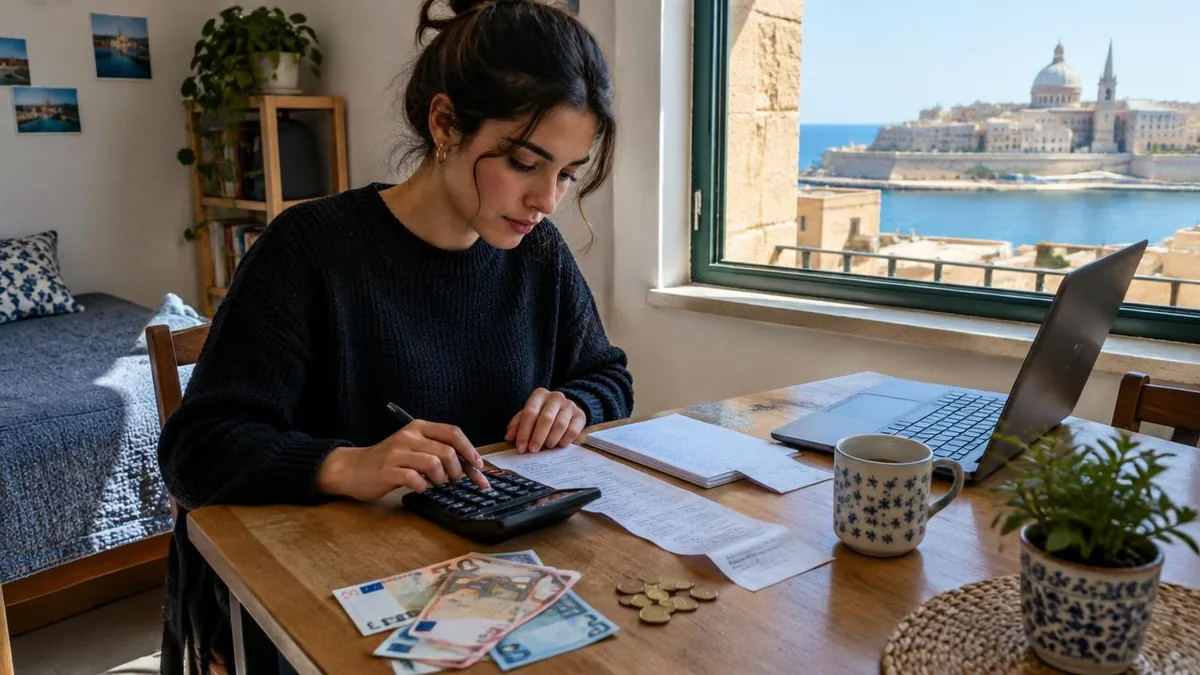
Studying in Malta costs most Pakistani students about PKR 35–55 lakh for the first year, including tuition of roughly €5,000–12,000 and living costs of about €800–1,100 a month. Rent is the largest living expense. The residence permit fee is only €50, while insurance and flights add smaller amounts.
| Cost item | In euro | In PKR (≈ €1 = PKR 320) |
|---|---|---|
| Tuition, private college Bachelor's or Master's | €5,000 – 10,000 / year | ≈ PKR 16 – 32 lakh |
| Tuition, University of Malta (non-EU) | €8,000 – 15,000 / year | ≈ PKR 26 – 48 lakh |
| Rent (shared room) | €400 – 650 / month | ≈ PKR 1.3 – 2.1 lakh / month |
| Food, transport and phone | €350 – 450 / month | ≈ PKR 1.1 – 1.4 lakh / month |
| Health insurance (min €100,000 cover) | €150 – 400 / year | ≈ PKR 48,000 – 1.3 lakh |
| Residence permit fee | €50 | ≈ PKR 16,000 |
| Flight Pakistan to Malta | - | ≈ PKR 1.5 – 2.5 lakh |
Rent in Sliema, St Julian's and Msida is the highest, because those areas sit near the University of Malta and nightlife. Students who share flats in Birkirkara or Mosta usually save €100–200 a month.
These figures are estimates for budgeting, not official fees. Tuition varies by course, so confirm each programme's fee on the university page.
Budget-focused students often compare Malta with Italy. The study in Italy from Pakistan page explains how income-based fees and regional grants can lower the total cost.
What are the admission requirements to study in Malta?
Admission requirements in Malta depend on the level. Bachelor's applicants need FSc, ICS or A Levels, and the University of Malta places Intermediate holders in a foundation year first. Master's applicants need a relevant Bachelor's degree. Most institutions also ask for IELTS or another English test, a passport and attested documents.
- Bachelor's: FSc, ICS or A Levels with the marks each programme sets.
- University of Malta: Intermediate holders usually join a foundation programme before the degree.
- Master's: a related Bachelor's degree, assessed case by case on CGPA.
- English: a Secure English Language Test such as IELTS, or a college's own accepted test.
- Documents: attested degree, transcripts, passport, CV and motivation letter.
- Some programmes: an interview, portfolio or entrance test.
Pakistani school certificates usually need IBCC attestation, and A Level results need IBCC equivalence. The IBCC equivalence for O and A Levels page explains that step.
University documents need HEC attestation before they are sent abroad. Students can follow the HEC degree attestation process while waiting for offers, and the PTE vs IELTS comparison helps pick the right English test.
How does the Malta student visa and residence permit work?
Pakistani students need a national (D) student visa to enter Malta, and then apply in person for a study residence permit after arrival. The permit application goes through Identità's Expatriates Unit, costs €50 and needs an acceptance letter, three months of bank statements, health insurance of at least €100,000 and a signed lease.
- 1Get the acceptance letter. Secure an offer from a licensed Maltese institution for a course at MQF level 5 or above.
- 2Pay the deposit if asked. Many private colleges ask for part of the first-year tuition before issuing visa documents.
- 3Prepare funds proof. Keep bank statements for the previous three months showing the required balance.
- 4Buy health insurance. Choose a policy with at least €100,000 cover, including hospital treatment.
- 5Apply for the student visa. Malta has no embassy in Pakistan, so book an appointment at an approved centre abroad, such as in the UAE, Qatar or Turkey. Plan for a total processing time of about 7 to 9 months.
- 6Travel and sign a lease. Rent a room and get a lease signed by both landlord and tenant, unless you use school housing.
- 7Apply for the residence permit. File online on the Expatriates Unit portal, then attend in person in Malta with a passport valid for six months.
- 8Collect the permit card. Use the card for travel within Schengen and for a part-time employment licence.
The two-stage process surprises many applicants. A visa only lets the student enter Malta, while the residence permit allows the student to stay for the full course.
Students compare this route with Germany in the Germany student visa from Pakistan page. Visa appointment handling in Pakistan can change, so confirm the current submission channel before booking.
When are the Malta intakes and application deadlines?
Malta's main intake is October, with applications open from about January to June at most institutions. Many private colleges also run February intakes and some offer rolling starts. Pakistani students should apply four to six months before the course begins, because the student visa and acceptance documents take several weeks.
| Stage | Typical timing | Notes |
|---|---|---|
| October intake applications | January – June | University of Malta closes earlier for non-EU |
| Offers and deposits | March – July | Private colleges issue offers within weeks |
| Student visa application | May – August | Apply as soon as documents arrive |
| Arrival and residence permit | September – October | Apply in person after arrival |
| February intake | Applications September – November | Mainly private colleges |
Visa demand peaks in summer. Applying early in the spring leaves time for a second appointment if documents are queried.
Can Pakistani students work part-time while studying in Malta?
Pakistani students in Malta can work part-time after their first three months of study, once they hold a residence permit and an employment licence from Jobsplus. Identità's student visa page sets the limit at 20 hours a week. Part-time work helps with rent and food, and it rarely covers tuition.
The official sources do not fully agree. The residence permit form N.01 mentions a 15-hour weekly limit, while Identità's visa employment page lists 20 hours after the first three months.
Students should follow the limit printed on their own employment licence. Working more hours than allowed can lead to a refused renewal.
Common student jobs are in hotels, restaurants, retail, delivery and customer support for gaming firms. Malta's minimum wage is modest, so 20 hours a week usually covers living costs only in part.
Ireland is the closest comparison, with the same English-speaking setting and a 20-hour rule. The study in Ireland from Pakistan page shows how its larger job market changes the picture.
Which scholarships help Pakistani students study in Malta?
Scholarships for Pakistani students in Malta are limited. Most funding comes as tuition discounts from private colleges, merit awards at some institutions and Erasmus Mundus joint Master's degrees that include a Maltese partner. Fully funded Malta government scholarships for Pakistani students are rare, so most students budget as self-funded applicants.
- Private college tuition discounts of about 10–30% for early payment or strong marks.
- Erasmus Mundus joint Master's programmes with the University of Malta as a partner.
- Commonwealth-linked awards when a call names Malta, which happens rarely.
- Employer or family sponsorship, which still needs the three-month funds proof.
The Erasmus Mundus scholarship page shows how to find programmes with a Maltese partner. The guide to scholarships for Pakistani students compares awards in countries where full funding is more common.
What mistakes should Pakistani students avoid when choosing Malta?
The most common mistakes are choosing an unlicensed college, applying for an English-language course that does not qualify for a study permit, showing funds only in the last few weeks, and expecting part-time work to pay tuition. Each mistake can lead to visa refusal, a refused permit or a large budget gap.
- Paying a deposit before checking the institution's licence.
- Choosing a course below MQF level 5, which does not qualify for a study permit.
- Depositing funds in a lump sum just before the visa application.
- Buying insurance with less than €100,000 cover.
- Arriving without a signed lease for the residence permit.
- Expecting a large graduate job market in a small country.
A free Malta profile check with our study abroad consultants compares your marks, budget and goals with the right college. Students weighing other options can read the study in Hungary from Pakistan page, another lower-cost EU destination.
Study in Malta from Pakistan, frequently asked questions
Is Malta good for Pakistani students?
Malta suits Pakistani students who want an English-speaking EU country with smaller classes and lower tuition than the UK or Ireland. The job market is small and tourism-led, so graduates in IT, gaming, finance and healthcare find more roles. Students should compare Malta with larger European countries first.
Can I study in Malta without IELTS?
Some private colleges in Malta accept an English-medium certificate or their own English test instead of IELTS. The University of Malta asks international students for a valid Secure English Language Test. Pakistani students should still prepare for an interview in English, because the visa officer checks spoken ability.
Is Malta a Schengen country?
Yes. Malta is part of the Schengen Area, so a Malta student visa and residence permit allow short visits to other Schengen countries. A Malta permit does not allow study or work in another country. Students who want to move to Germany or France later need that country's own permit.
How much bank balance is needed for a Malta student visa?
Malta's official rule asks for funds equal to at least 60% of the national equivalised income threshold for the year, shown in three months of bank statements. Competitor sites quote about €11,000–12,000. Pakistani students should confirm the current figure with the Identità Expatriates Unit before applying.
Can I bring my family to Malta as a student?
Family reunification is generally not available to most students on a study permit in Malta. Spouses and children usually need their own visa category, and approvals for dependants of students are rare. Pakistani students planning to bring family should check the current rules with Identità before choosing Malta.
Is MBBS in Malta possible for Pakistani students?
Medicine in Malta is offered mainly by the University of Malta and a few private medical schools, with limited seats for non-EU students and high fees. Pakistani students who want to practise at home must also meet PMDC rules for foreign medical graduates, so they check recognition before applying.
Can I stay in Malta after graduation?
Graduates who find a job can switch to a Single Permit, which combines residence and work in Malta. Employers usually apply for it on the graduate's behalf. Rules on post-study job-search periods change, so Pakistani students check the current position with Identità and Jobsplus before their final semester.